ejour_adm

We have noted an ongoing interest for the anaesthetic practices for caesarean section (CS) throughout Europe, which may differ from one country to the other for several reasons. In a very recent EJA article, a national survey in the Czech Republic and Slovakia has shown that national audits may allow and promote focusing on education and interstate cooperation. Impressively, even if the two countries were united in the past, the rate of general anaesthesia (GA) for CS in the Czech Republic was lowered from 34 to 26% for elective and from 59 to 39% for non-elective CS. This was not the case for the neighboring Slovakia, where the rate for GA was already low. Besides, in a 2017 survey from Austria, the rate of routine use for regional anaesthesia for CS reaches almost 100% and in France has a similar trend. Continue reading
Mitochondrial diseases represent a wide range of disorders caused by impairment of mitochondrial metabolism and energy production. We report a case of an uneventful perioperative management of a pregnant patient with early childhood-onset mitochondrial encephalopathy, attributed to a novel AIFM1 (Apoptosis-Inducing Factor, Mitochondrion-associated 1) mutation. After a multidisciplinary team consultation, it was decided to be posted for elective caesarean delivery at 36+2 weeks of gestation, under titrated combined spinal-epidural anaesthesia and multimodal analgesia. Unique anaesthetic challenges were to ensure normoglycaemia, normothermia and adequate hydration while avoiding perioperative stress and acidosis. Continue reading
Intravesical bacillus Calmette-Guerin (BCG) therapy, recommended for superficial bladder tumors, triggers side effects in fewer than 5% of patients. Yet, when encountered, high level of suspition and early detection is essential for their succesfull management. In the present article, we present a case of severe sepsis and Steven Johnson syndrome in a male patient after intravesical BCG instillation. Intravesical instillation of Bacillus Calmette-Guérin (BCG) is frequently used as the treatment of choice for carcinoma in situ and non-invasive high-grade superficial tumor of the urinary bladder1. BCG is a live attenuated strain of Mycobacterium bovis and is the most widely used intravesical agent2. Adverse events occur in fewer than 5 % of cases, ranging from mild local symptoms to severe sepsis and death1-3. In the present article, we report a case of successful management of septic shock with concomitant Steven Johnson syndrome after intravesical BCG instillation and perform a short review of the relevant literature. Continue reading
Pericardial decompression syndrome (PDS) is a rare but eventually fatal syndrome, which occurs after pericardial drainage. In this report we describe a patient who suffered from cardiovascular collapse and pulmonary edema after pericardial drainage. A male patient aged 42yrs complained of progressive dyspnea over the past 2 months and presented with clinical signs of pericardial tamponade. The patient underwent a surgical subxiphoid pericardial drainage under general anesthesia and mechanical ventilation. After pericardial drainage of 2.2lt, the patient was transferred to the Intensive Care Unit, where he was extubated2 hours later. Immediately after extubation, he showed clinical signs of cardiovascular collapse and pulmonary edema. The patient was reintubated immediately and placed on mechanical ventilation. He was extubated after 12hrs. His postoperative course was uneventful and he was discharged from the hospital after a few days. Continue reading
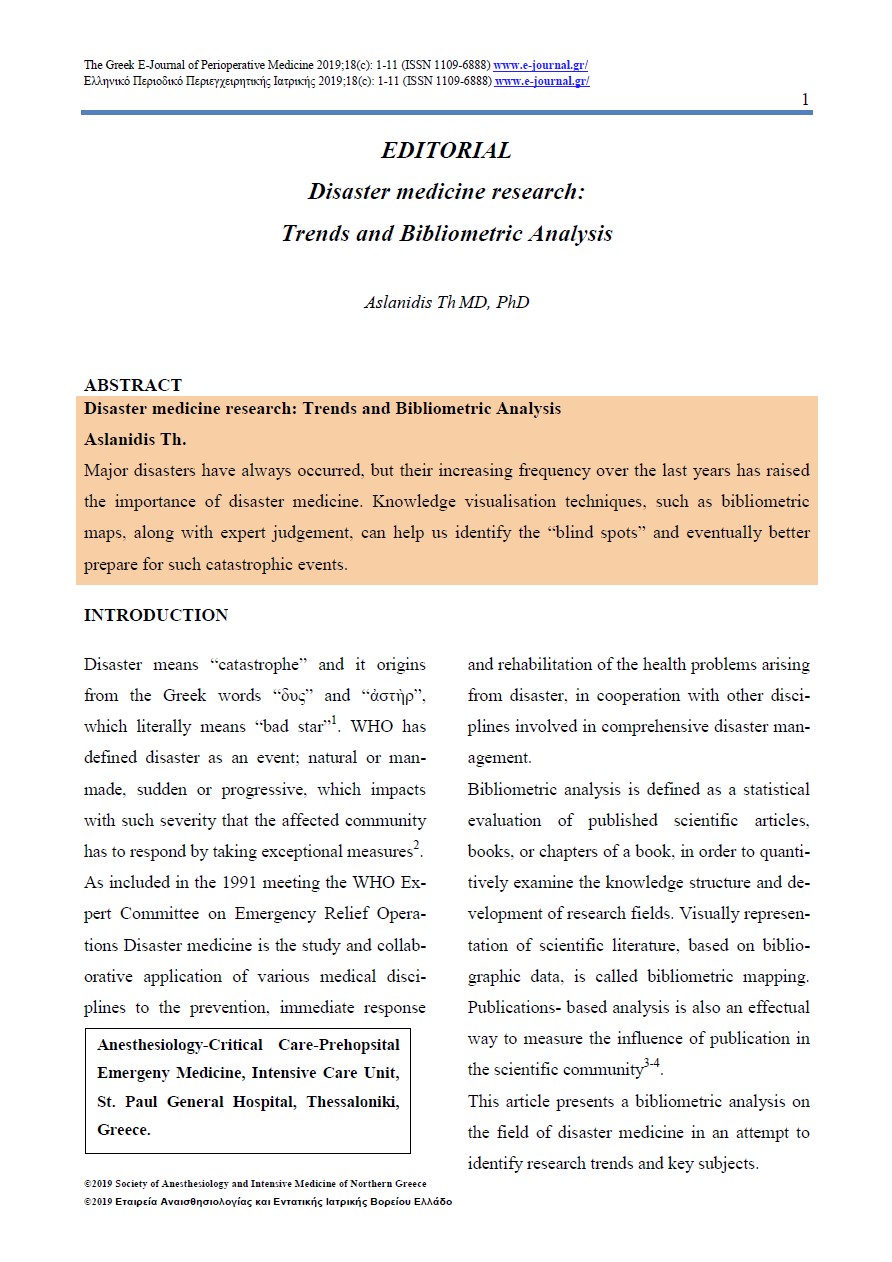
• EDITORIAL - DISASTER MEDICINE RESEARCH: TRENDS AND BIBLIOMETRIC ANALYSIS.
• Η ΗΘΙΚΗ ΤΗΣ ΑΝΑΖΩΟΓΟΝΗΣΗΣ ΜΕ ΤΑ ΜΑΤΙΑ ΑΥΤΩΝ ΠΟΥ ΤΗΝ ΕΦΑΡΜΟΖΟΥΝ.
• REGIONAL ANESTHESIA AS AN INDIVIDUALIZED APPROACH FOR A PATIENT WITH SYRINGOEMYELIA AND SEVERE PULMONARY HYPERTENSION UNDERGOING SURGERY FOR HIP FRACTURE. A CASE REPORT.
• METFORMIN – ASSOCIATED LACTIC ACIDOSIS TREATED WITH CONTINUOUS RENAL REPLACEMENT THERAPY IN A CRITICALLY ILL PATIENT: CASE REPORT AND REVIEW OF THE LITERATURE. Continue reading
Major disasters have always occurred, but their increasing frequency over the last years has raised the importance of disaster medicine. Knowledge visualisation techniques, such as bibliometric maps, along with expert judgement, can help us identify the “blind spots” and eventually better prepare for such catastrophic events. Continue reading
Codes of ethics are considered as indispensable parameters of every aspect of medical care. When performing cardiopulmonary resuscitation (CPR) ethical issues become even more important since cardiac arrest (CA) is directly related to death. The aim of this study was to record personal opinions and everyday clinical practice approaches of healthcare professionals (HCPs) regarding ethical issues related to CPR. HCPs answered a questionnaire consisting of 30 questions related to ethical issues in CPR on a voluntary basis. The study included 195 HCPs (88♂& 107♀). Out of the 195 HCPs, 95 were physicians, 71 nurses and 29 paramedics. 49 HCPs (25.1%) worked in the prehospital setting (EMS or Healthcare Centers) and 147 (74.9%) in hospitals. Continue reading
Anaesthetic management of patients with comorbidities can be challenging and requires rigorous planning. Peripheral nerve blocks (PNBs) do not compromise haemodynamics or pulmonary function. We present the management of a patient with symptomatic syringomyelia, severe pulmonary hypertension, thrombophilia and obstructive sleep apnoea undergoing hip fixation. Combined psoas compartment and sciatic nerve block was conducted and the patient remained stable perioperatively. She had an uneventful recovery and was discharged three days later. Patients with multiple comorbidities are subject to high perioperative risk and should be managed individually. Regional anaesthesia can be a last resort that leads to a better outcome. Continue reading
Though metformin is considered as first choice drug in type II diabetes, clinicians should be alert both for presence of potential contraindications to its use and to possible adverse reactions. Bad therapy compliance along and/or concomitant comorbidities may lead to serious toxicity. We hereby describe a case of extreme lactic acidosis- associated with metformin therapy- in an elder woman, managed with Continuous Renal Replacement Therapy in Intensive Care Unit environment. Short review of the literature about the place of renal replacement therapy in such cases is also discussed. Continue reading
Γλώσσα
Αναβάθμιση του Impact Factor

Ιστορικό
ATOM Feed
RSS Feed
RDF Feed
Άδεια Creative Commons