


The pericardial diseases result in cardiovascular perturbations ranging from asymptomatic electrocardiographic findings (in pericarditis of end-stage renal disease) to circulatory shock (in acute hemorrhagic pericardial tamponade). Despite of clinical features that resemble right-, or left-side failure, the clinical management of pericardial pathology may differ significantly from those of ventricular systolic or diastolic dysfunction. Therefore, prompt diagnosis and appropriate medical or surgical therapy is imperative.
Continue readingSince the advent of clinical anesthesia, there has been a continuous need for evaluating the depth of anesthesia. Depth of anesthesia was always important in avoiding either overdose (toxicity) or “underdose” (administering less than absolutely necessary). The problem of overdosing has been partly solved by assignment of dedicated and specially trained doctors to provide anesthesia services, by accumulating more than a 100 years of experience in administering anesthesia, by using safer drugs (volatile and intravenous) with extremely smaller toxicity than the older ones and by recognizing and establishing the stages of anesthesia (such as Guedel stages) and the hemodynamic parameters as indirect but useful indices of the depth of anesthesia. The current trend of minimizing expenses of anesthesia calls for tight titration of drug administration.
Continue readingOne of the few areas in clinical medicine which is more affected by advances in engineering technology is cardiac pacing. In about half a century since the first implantation of a pacing system, there has been a significant progress concerning the pacing devices and along with the growing number of new indications for pacing, this will lead to an increasing number of implanted devices over the following years.
Continue reading
Pain has been defined by the International Association for the Study of Pain as “an unpleasant sensory and emotional experience associated with actual or potential tissue damage or described in terms of such damage”. However, the ability to describe the concept of pain is difficult largely because pain is an individualized and subjective experience. The mechanisms of nociception in animals have been found to resemble closely those present in humans.
Continue readingThis study was undertaken to examine the impact of the variations of cardiac mechanical work in heart’s respiratory quotient (RQ) and venoarterial carbon dioxide difference (ΔPCO2). In twenty-seven patients undergoing coronary artery bypass grafting under extracorporeal circulation, a coronary sinus line was instituted and it’s correct position was verified by the waveform displayed in the monitor. Immediately after cannulae placement, a haemodynamic profile was obtained and simultaneous arterial and coronary sinus (a & cs) sampling for blood gas analysis was done in an ABL 720 (Radiometer Copenhagen) analyzer.
Continue readingIn this study we compared the efficacy of three methods of analgesia following total knee arthroplasty (TKA). Fifty-seven patients (n=57), with mean age 70 + 5 and physical status ΑSA I-III, were scheduled for TKA and were randomly allocated in into three groups. Group A patients (n=19) received analgesia by continuous iliac fascia block (CIFB), group B patients (n=19) received continuous epidural analgesia (CEA) and group C patients (n= 19) received intramuscular pethidine at regular time intervals.
Continue reading
Atropine has been used in the past as a premedication drug to decrease the sialorrhea of the second stage of anaesthesia and prevent bradycardia caused by the administration of succinylcholine, opiods or volatile anaesthetics. The purpose of this study is the investigation of the haemodynamic fluctuations during induction of anaesthesia and intubation of the trachea, in children and adults either premedicated or not with atropine.
Continue readingSince its identification as the active metabolite of nitroglycerin identical to endothelium derived relaxing factor, in mid-eighties, nitric oxide has been found over-all distributed in all body tissues implicated in many normal functions as well as pathophysiologic states, so that it has been aptly called biological jack-ofall- trades.
Continue reading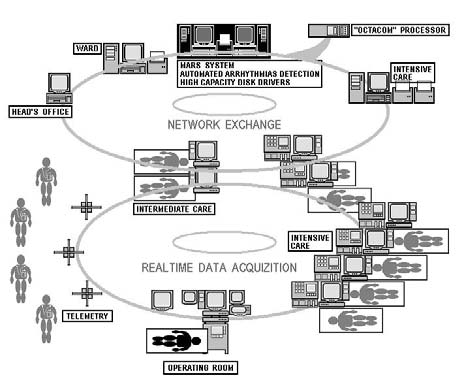
Patients are almost unlimited data generators. Nowadays, handling data can be easily and accurately supported by technology.
Continue reading


