

Management of epileptic patients in the perioperative period is an anesthetic challenge. New drugs and surgical procedures are being used to treat epilepsy. Various anaesthetics exhibit both proconvulsant and anticonvulsant properties at different doses and under different physiologic conditions. Continue reading
The management of cardiologic patients who are presenting for diagnostic and theurapeutic cardiac interventions has become a significant topic of interest and concern among anesthesiologists. This review will update recent reports and also will provide practical advice on delivering anesthesia in cardiac catheterization laboratory. During recent years cardiac procedures are more complex, take longer, and involve high risk patients.
Continue readingThe objective of this study was to evaluate onset times and tracheal intubating conditions after administration of rocuronium or mivacurium in children of different ages. In this randomized double-blind study, 40 healthy (ASA I) children aged 1 to 14 years were studied. They were divided, according to age, into two groups: Group A (n=20) included patients 1 to 3 years of age and Group B (n=20) 4 to 14 years of age. After general anesthesia induction patients in both groups were further divided into two subgroups.
Continue readingCell protection against hypoxia can be mediated by brief periods of sublethal ischemia, a phenomenon called ‘preconditioning’. The molecular mechanisms that are responsible for cell protection are extremely complicated; however, extensive research in molecular biology and cellular physiology has uncovered many different signaling pathways, especially in cardiac tissues.
Continue reading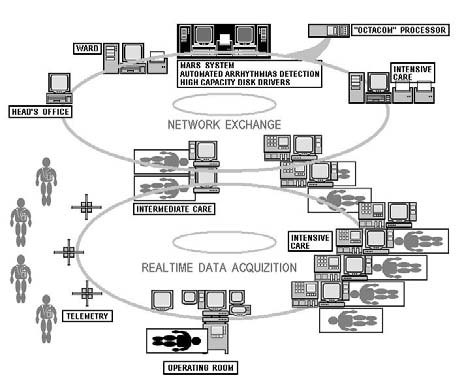
Patients are almost unlimited data generators. Nowadays, handling data can be easily and accurately supported by technology.
Continue reading


