ejour_adm

Patient care in Intensive Care Units is characterized be high demanding tasks, which lead in daily high workload. In the present study, a questionnaire-based evaluation of ICU nurse’s workload was conducted at the adult general 7 - beds ICU of a small urban hospital. NASA Task Load Index (TLX) along with other two tools, used for the first time in healthcare environment: Instantaneous Self-Assessment (ISA) and Crew Status Survey (CSS) were used for that purpose. Information about every nurse’s professional background and basic demographics were also collected. Responses from 70% of total nurse staff were collected. Continue reading
The number of pregnant women with morbid obesity (BMI 40–49.9 kg/m2) has significantly increased worldwide. Management of these patients presents a challenge for obstetric anesthesiologist. We report our management of cesarean delivery in a parturient with a BMI 47.3 kg/m2. We present this case to emphasize usefulness of Tuohy needle as an introducer for performing spinal anesthesia with a long 27G pencil point needle. Literature review is discussed. Continue reading
Hemophagocytic Lymphohistiocytosis (HLH) is a life-threatening syndrome of excessive immune activation that mostly occurs as primary (hereditary) disease in children. Acquired HLH is associated with infections, cancer of rheumatological conditions. Both are rare in adults. Turicella otitidis is a bacterium, that is associated with ear infections and there is only one case report of bacteraemia. The present report describes a case of acquired HLH with invasive pulmonary Aspergillosis and Turicella otitidis bacteraemia in an adult patient; and also reviews the relative literature. In conclusion though rare, acquired HLH is a devastating condition that clinicians should have in mind when managing patients with multiple infection or underlying immunosuppression. Continue reading
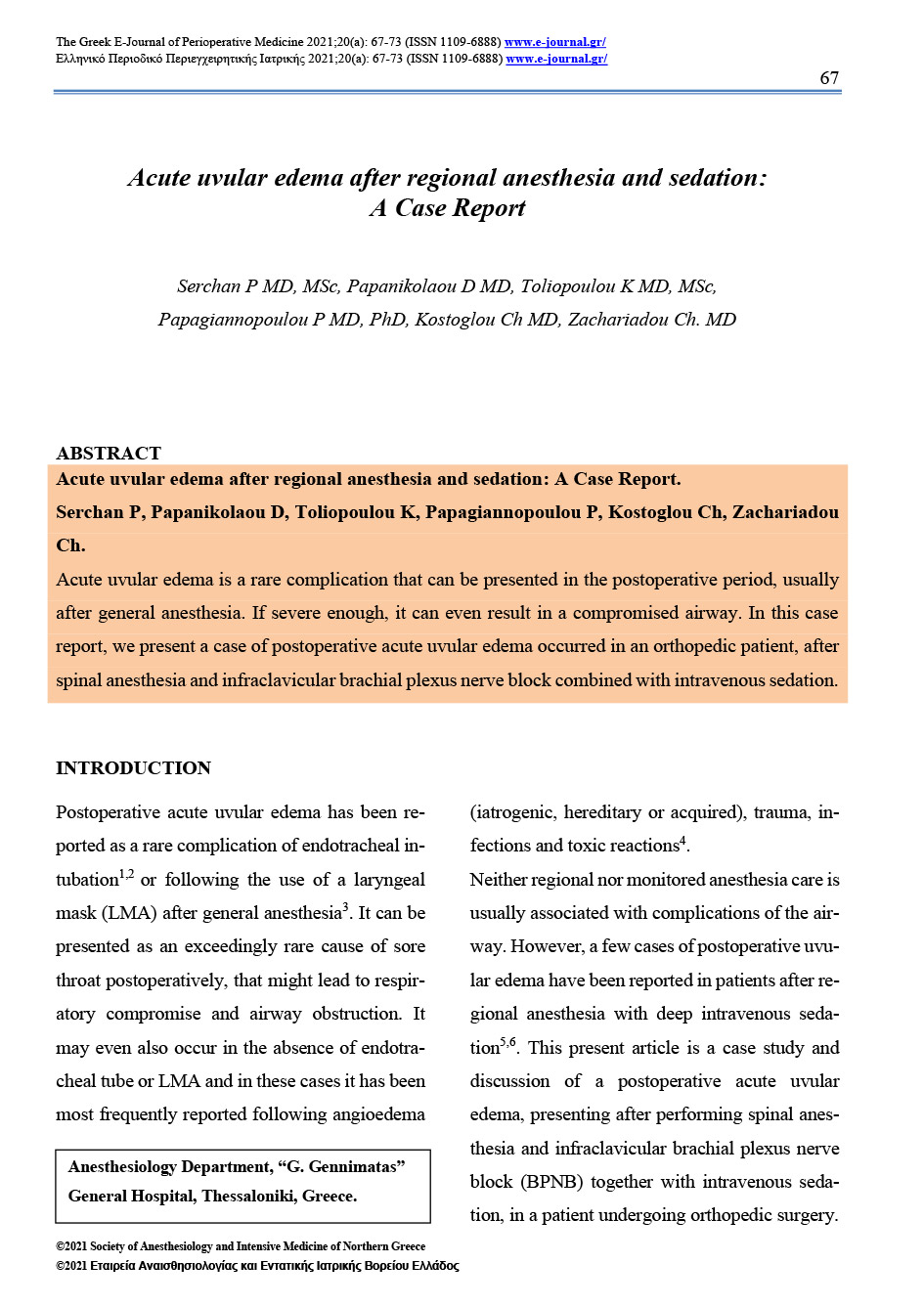
Acute uvular edema is a rare complication that can be presented in the postoperative period, usually after general anesthesia. If severe enough, it can even result in a compromised airway. In this case report, we present a case of postoperative acute uvular edema occurred in an orthopedic patient, after spinal anesthesia and infraclavicular brachial plexus nerve block combined with intravenous sedation. Continue reading
The third issue of the Greek e-journal of Perioperative Medicine for 2020 covers a wide range of interest in perioperative scientific articles. The first article of this issue is a narrative review of Staikou Ch et al, which identifies, in the existing literature, the providing information about the development of chronic pain after ICU stay. This article discusses the epidemiology, the risk factors, the pathophysiology and the treatment of chronic pain in intensive care survivors. The authors conclude that chronic pain after ICU stay demands vigilance, care and an individualized multimodal analgesic regimen, in order to improve the quality of surviving patient’s lives. Continue reading
Patients admitted to Intensive Care Units (ICU) have the highest mortality rates among hospitalized patients. For those who survive, recovery is often a prolonged rehabilitation period with physical, cognitive and psychological dysfunction. The aim of the present narrative review was to identify in the existing literature articles providing information about the development of chronic pain after ICU stay. We performed a PubMed search for publications up to 22 March 2020. We identified 41 articles eligible to be included in the present review; 29 of them were original research articles. Pre-existing chronic pain, previous poor health- related quality of life (HRQoL), but also the critical illness itself and organ support with multiple interventions, predispose to the development of chronic pain in the post-critical period, making it difficult to return to the pre-disease functional status. Opioid administration during mechanical ventilation is a common practice, frequently without reliable and systematic assessment of pain or individualized titration of dosage. Continue reading
Postdural puncture headache (PDPH) may occur after inadvertent dura mater puncture inepidural anaesthesiaor after spinal puncture in spinal anesthesia, spinal diagnostic or therapeutic procedures. It is characterized by severe headache that occurs within 5 days following thepuncture, located in the frontal and/or occipital region, not necessarily worsened in the upright position. PDPH is associated with substantially increased postpartum risks of major neurologicand other maternal complications, underscoring the importance of early recognition, follow up andtreatment particularly in obstetrics. Despite the fact that epidural blood patch is recognized as thegold standard in the treatment of PDPH, it is not without risk andpotentially may fail. Nerve blocks andnewer therapieshave been reported that could be efficacious, easy to administer and with less risk. In this review wepresent updated evidence and potential alternative therapies in the treatment of PDPH. Continue reading
Nosocomial infections continue to increase all over the world and remain a major cause of morbidity and mortality in hospitals. There are three elements required for the transmission of nosocomial infections: a reservoir of microbial agent, a susceptible host with a portal of entry receptive to the agent and a mode of transmission for the microbial agent. Microorganisms that cause nosocomial infections derive primarily from human sources1-3 , but inanimate environmental sources are implicated in transmission4. Human reservoirs include patients, healthcare personnel, household members and visitors5. People in hospitals are usually already in a ‘poor state of health’, impairing their defense against bacteria. Invasive devices impair natural lines of defense against pathogens and provide an easy route for infection. Patients already colonized at the time of admission are instantly put at greater risk when they undergo invasive procedures6. Continue reading
Pneumothorax is a collection of air in the pleural space between the lungs and the chest wall and depending on its cause it could be either spontaneous or traumatic. Tension Pneumothorax (TPT) can be a cause of cardiac arrest (CA) or might be a complication after chest compressions. According to the 2015 European Resuscitation Council guidelines on resuscitation, TP is considered one of the reversible causes of CA, which should be recognized and treated during cardiopulmonary resuscitation (CPR) Continue reading
Language
Αναβάθμιση του Impact Factor

Archives
ATOM Feed
RSS Feed
RDF Feed
Creative Commons License