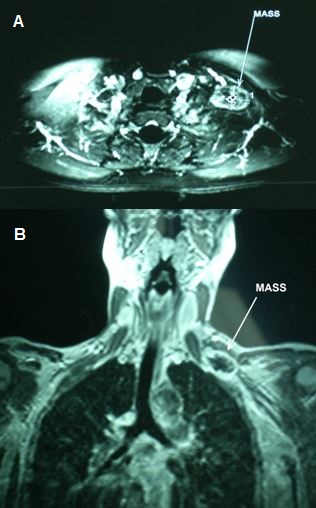
Schwannomas, known also as neurilemmomas, are considered to be benign in the vast majority of cases. Originating from the schwan cells of the neural sheath of peripheral nerves, they usually develop in the head and neck. Involvement of the brachial plexus is relatively rare, with an incidence of 0.3–0.4/100,000 person per year1. Malignant transformation is extremely uncommon. Patients’ initial symptoms include pain, loss of function, numbness or a progressively growing mass in the supraclavicular region. Neglected cases regarding larger benign tumors may present with monoparesis of an upper limb2. Primary malignant schwannomas of the brachial plexus causing monoplegia are extremely infrequent and to the best of our knowledge very few cases have been published in the international literature.

Continue reading →

Dear colleagues,

The Society of Anesthesiology and Intensive Medicine of Northern Greece with great pleasure welcomes the new site of the Greek e-Journal of Perioperative Medicine (www.e-journal.gr).

From 2004, the presence of the the Greek e-Journal of Perioperative Medicine among the National Scientific Journals has been gradually increased. In this open access e-journal, material submitted for publication include articles in the field of Perioperative Care, Anesthesia, Critical care, Pain and Emergency Medicine. In this new effort the online journal (www.e-journal.gr) has the full support of the Society of Anesthesiology and Intensive Medicine of Northern Greece, looking forward to your further fruitful cooperation, hoping to continue the decent progress so far in the area of the Greek and the international medical press.

Vassilis Ourailoglou

President of Society of Anesthesiology and Intensive Medicine of Northern Greece

Continue reading →

Intrathecal drug administration extends beyond the purposes of anaesthesia, to therapeutic applications. Here, we describe the case of a patient with severe Systemic Lupus Erythematosus having affected multiple organs and had a meningococcal infection. She was treated with intrathecal antibiotic therapy resulting in a successful outcome.

Continue reading →
Continue reading →

Αγαπητοί συνάδελφοι,

Εκ μέρους της επιτροπής σύνταξης του Ελληνικού Περιοδικού Περιεγχειρητικής Ιατρικής σας ευχαριστούμε πολύ για τη μέχρι σήμερα εμπιστοσύνη και συνεργασία.

Προκειμένου να συνεχίσουμε και να διευρύνουμε την πορεία του περιοδικού στο χώρο τόσο του ελληνικού όσο και του διεθνούς ιατρικού τύπου, επιδιώκουμε τον εκσυγχρονισμό του περιοδικού.

Continue reading →

The purpose of this study (prospective one year study of all patients requiring a central line) is to present central line colonization, central line infection, central line-associated and catheter-related bloodstream infection rates, risk factors, and the outcomes in a multidisciplinary Greek pediatric intensive care unit.

81 patients required 136 episodes of catheterization with duration of 9 (5.25-14.75) days. Device utilization ratio was 0.8. Eleven patients developed 17 episodes of central line-associated blood-stream infection (CLABSI) in 1629 catheter days, given a CLABSI rate of 10.43:1000. 3 catheter tip cultures revealed the same microorganism as the bloodstream infection (BSI), specified a catheter-related (CRBSI) rate of 1.84:1000. Catheter tip infection occurred at a rate of 3.69:1000, whereas catheter colonization at 8.59:1000. Gram-positive microorganisms predominated in CLABSIs (52.94%), whilst Gram-negative pathogens predominated in colonization (64.28%), infection (66.66%), and CRBSI (66.66%), Acinetobacter baumanii being the principal pathogen. CLABSI patients had longer duration (days) of catheterization (17 vs 9, P=0.014), mechanical ventilation (17 vs 8, P=0.014), and unit stay (17 vs 10, P=0.037), without an impact on mortality. CLABSIs occurred more often in patients with Hickman catheters (P=0.003), co morbidities (P=0.000), multiple catheterizations (P=0.003), complications (P=0.008) and corticosteroid use (P=0.044). Hickman catheters [odds ratio (OR) 8.381; 95% confidence intervals (CI): 1.1-66.1, P=0.044]and co morbidities [OR: 5.904; 95% CI: 1.2-28.9, P=0.029)] were independent predictors of CLABSIs.

CLABSI rate in our study is higher than the international standards. Preventive measures, such as improvements in central line insertion and maintenance bundles of care, are necessary, to lower this baseline rate in future comparisons.

Continue reading →

The aim of this case report is to demonstrate the efficacy and safety of Continuous Spinal Anesthesia (CSA) in an elderly patient with severe Chronic Obstructive Pulmonary Disease (COPD), who was scheduled for elective laparoscopic cholecystectomy.CSA can be used to provide a sufficient block in order to allow laparoscopic cholecystectomy to be performed even in patients with severely abnormal respiratory function. Safety, efficacy and a decreased need for postoperative analgesia render this approach a valid option for patients with symptomatic gallstone disease, who are poor candidates for general anesthesia due to cardiorespiratory or airway problems as well as for patients with other contraindications for general anesthesia.

Continue reading →

Syncope is a common complaint in clinical medical care. Except of neurological disorder, most of the patients havea brief benign clinical course with spontaneous recovery. Etiology may range from benign disorders to severe life-threatening diseases.Syncope as the leading symptom in patients suffering from intrathoracic neoplasm is uncommon. A rare case of a giant pleural solitary fibrous tumor causing recurrent episodes of syncope is presented. Diagnostic considerations and therapeutic strategy are discussed.

Continue reading →

Factors affecting cardiac function in dialysis patients include arterial blood pressure, anemia, intra-vascular volume and the arteriovenous fistula (AVF). We investigated the acute and chronic effects of basilic vein transposition (mean upper arm brachial artery-basilic vein anastomosis) on both the cardiovascular system and the oxygen status.

Sixteen patients with end stage renal failure were enrolled in this study. Patients with heart failure, pericardial effusion or valvular heart disease were not included in the study. Echocardiography (preoperatively and six months after, stages 1 and 2 respectively) and a Swan-Ganz catheter (perioperatively) were used to assess the hemodynamic status during the phases of AVF construction. Flow measurements were made in the parts of the AVF system before, during and after the construction of the AVF.Moreover, at the same time phases blood sampling from the arterial line and the pulmonary artery catheter was performed, in order to assess oxygen and acidbase status.

Continue reading →

The incidence of pre-eclampsia in the western countries is estimated to range from 2% to 6% in healthy, nulliparous women. In developing nations, the incidence of the disease is reported to be 4- 18%,with hypertensive disorders being the second most common obstetric cause of stillbirths and early neonatal deaths in these countries Etiology of the disease is multifactorial, with risk factors like maternal age, oxidative stress, angiotensin T-235 homozygote having a different role in every case. Moreover, the disease its self is a multisystem expression of a complicated pathophysiology. Many attempts to explain the latter have been made with often controversial results. In the present article we explore the hypothesis of intra-abdominal pressure as possible causative factor of pre-eclampsia and the role ofthe maternal venous compartment and rennin-angiotensin-anldosterin system in this hypothesis.

Continue reading →

Language

Αναβάθμιση του Impact Factor

Archives

ATOM Feed
RSS Feed
RDF Feed
Creative Commons License